

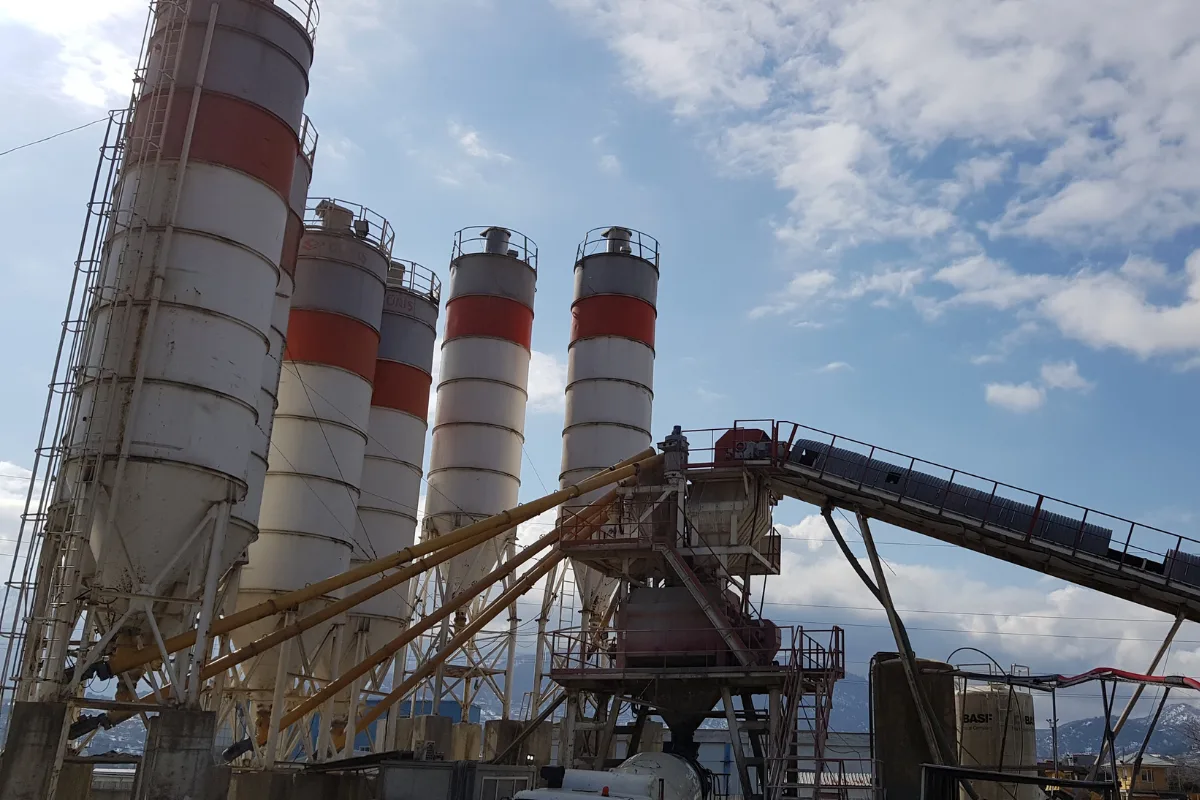
The Importance of Maintenance and Using the Right Spare Parts in Concrete Batching Plants, Transit Mixers, and Concrete Pumps
The concrete production chain typically follows Batching Plant → Transit Mixer → Concrete Pump. A failure at any point in this chain can affect the entire operation—causing direct financial losses and serious issues in concrete quality. Even a minor breakdown or performance drop in one of these machines is rarely just a “machine repair cost”; it can impact concrete quality, site productivity, labor, fuel, returned concrete, delay penalties, and customer satisfaction at the same time. For this reason, maintenance planning and spare-part selection are directly linked to total cost and concrete quality.
1) Cost impact: Downtime is the hidden big bill
In the field, the most expensive failures are usually those that cause unexpected downtime, because:
The jobsite waits: If the pump stops, placing is interrupted; crews and equipment wait.
Concrete degrades: The longer the concrete stays in the mixer, the more workability can decrease; returns or “rescue” admixtures add cost.
Fuel and labor increase: Mixer and pump may idle; maneuvering/cleaning time grows.
Planning breaks: The delivery chain is disrupted, shifts slip, and recovery costs appear.
Preventive maintenance (periodic checks, oil changes, filters, seals, wear parts) is often far cheaper than emergency repair. The key point is: maintenance costs are controllable; failure costs are surprises that grow quickly.
2) Concrete quality: Equipment condition directly affects quality
Concrete quality is not only a recipe issue. Dosing accuracy, mixing homogeneity, water-cement ratio, admixture control, and transport/placing time all matter.
In the batching plant:
Worn gates/valves and leaking covers can cause dosing errors.
If moisture measurement and scale calibration drift, the water-cement ratio changes—raising strength and shrinkage risks.
Mixer wear, paddle and liner loss reduce homogeneity, leading to segregation and consistency variation.
In the transit mixer:
Wear in the spiral and drum makes it harder to preserve the mix during transport.
Water tank/line problems or improper interventions can trigger wrong practices on site (e.g., adding water), reducing strength.
As chutes and wear parts deteriorate, discharge control drops and contamination risk increases.
In the concrete pump:
Wear on the S-valve, wear/cutting rings, pistons, and seals increases pressure loss, efficiency drop, and blockage risk.
Pipe/bend/clamp/gasket issues cause leakage, pressure fluctuations, and safety risks.
Irregular pressure and discontinuous flow can worsen placement quality, increasing segregation, voids, and surface defects.
Summary: Poorly maintained equipment can produce different results even with the same mix design.
3) Choosing the right spare parts: “Cheap parts” often become expensive
When price is the only criterion, risks increase:
Dimensional mismatch: Tolerance issues cause early wear, leakage, vibration, and performance loss.
Material quality: Wrong hardness/alloy dramatically shortens wear-part life.
Failure chain: A weak part stresses others (e.g., pump wear → pressure fluctuation → higher load on pipes/clamps).
Unplanned downtime: More frequent replacements raise labor and downtime costs.
Therefore, parts manufactured to OEM standards, with correct material and tolerances, usually deliver a lower total cost even if the purchase price is higher.
4) Practical approach: Simple maintenance and stock strategy
What works best on site is typically:
Critical parts list: Pump piston/seals, S-valve wear set; plant mixer paddles/liners; mixer spiral and wear parts.
Routine inspections: Leaks, pressure fluctuations, noise/vibration, oil and filter condition.
Calibration and records: Scales, moisture sensors, water dosing; keep records of every intervention.
Planned replacement: Change wear parts before performance drops—not after failure.
Conclusion
Batching plants, transit mixers, and concrete pumps form a system that determines both concrete quality and project pace. Maintenance and the right spare parts are strategic investments—not only to avoid failures, but to standardize quality, increase productivity, and reduce total cost. Planned maintenance replaces “surprises” with control—improving both quality and profitability.