

Why Is the Concrete Batching Plant Mixer Lubrication System Critical? The Most Effective Way to Prevent Bearing and Shaft Failures
Mixer Lubrication System in a Concrete Batching Plant: The Hidden Key to Production Continuity
In a concrete batching plant, the mixer is the most critical piece of equipment that determines production continuity. That’s why a “healthy” mixer is not only about paddle-liner wear; it also depends directly on a system that is at least as important: the mixer lubrication system. Because mixer bearings and main shafts operate under high load and constant vibration, damage accumulates quickly when lubrication is insufficient. This damage rarely appears all at once; it typically starts as a silent loss of performance, then progresses to increased heat and noise-vibration, and finally ends in severe failures that make the bearing–shaft group unusable on site. When lubrication is neglected, the failure does not target just one part—it targets the most expensive and hardest-to-repair section of the mixer.
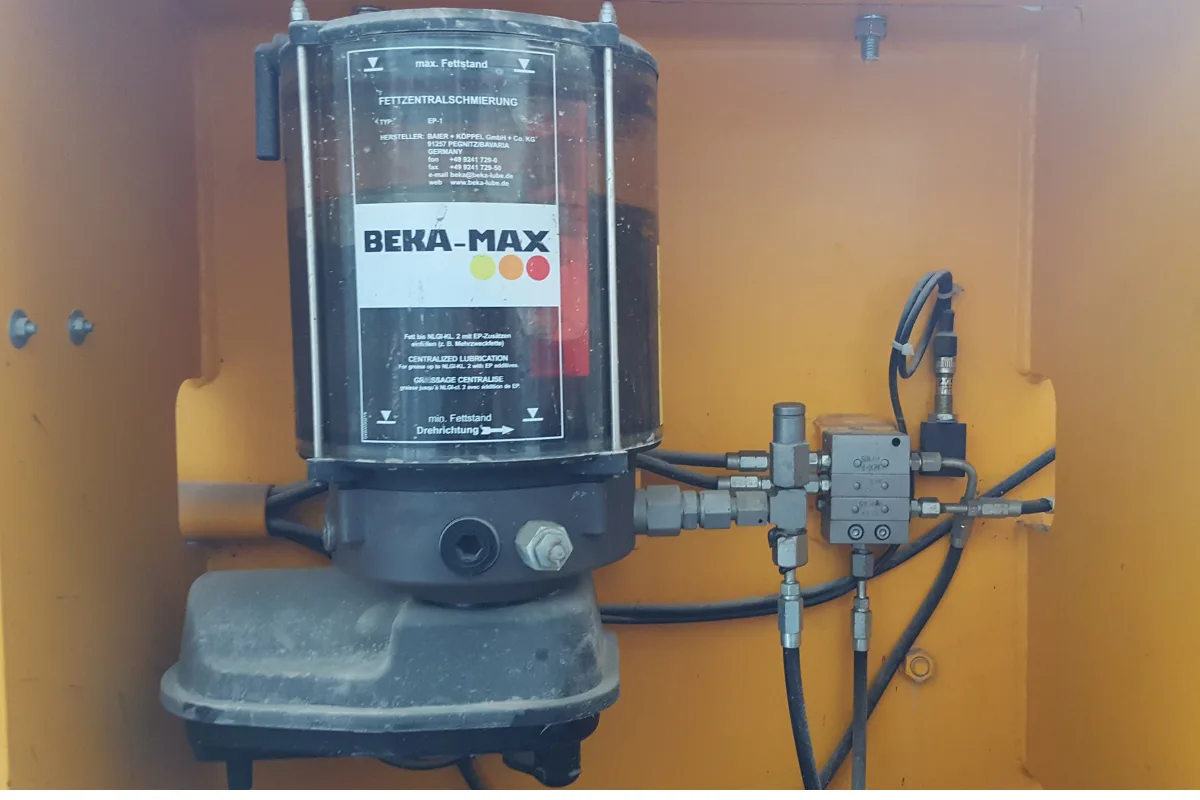
A common field mistake is reducing lubrication to a simple “present/absent” check. The real question is: does the centralized lubrication system deliver the correct amount of grease/oil to the bearings? The pump may be running, but if the distributor block, lines, nipples, or metering elements (dosing/cycle setting) have issues, lubricant can leak to another point or may not reach some lines at all. In that case, no lubricant film forms at the bearing; metal-to-metal contact begins, bearing temperature rises, and the shaft surface gets scored—creating damage that is difficult to reverse. In practice, the phrase “if the bearing fails production stops; if the shaft fails production stops for a long time” summarizes why lubrication is a strategic topic.
What happens when lubrication is disrupted?
Insufficient lubrication leads to bearing overheating, grease breakdown, loss of the lubricant film, and increased friction. As damage grows, wear/scoring appears on the shaft surface and repair cost multiplies. When bearing tolerances degrade, clearance and misalignment increase, and that misalignment loads other mixer components as well. As heat and vibration rise, seal life shortens; cement-dust-moisture can enter the bearing area more easily. Ultimately, unplanned downtime becomes unavoidable, and in the concrete production chain (plant → truck mixer → pump) a single stoppage can affect the entire jobsite.
Where is the weak link in the lubrication system?
Mixer lubrication problems often originate from small but critical components. The automatic lubrication pump may generate pressure, yet lubrication can still be inadequate if dosing/cycle is insufficient (wrong setting, incorrect cycle time). If the progressive distributor clogs or sticks, lubricant will not reach some lines. Hoses/pipes can be crushed, broken, or cracked. If there is leakage at nipples and connection points, lubricant is expelled outside instead of reaching the bearing. If the grease/oil in the reservoir becomes contaminated or the level drops, the pump can draw air and delivery becomes irregular. The wrong grease/oil selection also weakens the system in terms of water resistance, EP additives, and operating temperature. The key point is: the lubrication system is made of small parts, but its failure destroys big parts (bearing–shaft).
Periodic checks: short checks prevent major failures
A large portion of mixer bearing failures can be caught early with a simple routine. Daily or at shift start, check reservoir level, pump operation, and whether there is abnormal heat/noise/vibration at the bearing area. Weekly, inspect distributors and line connections for leakage, check for crushed/broken lines, and verify actual lubricant output at selected points. Monthly/periodic maintenance should include checking pump elements, filters, and distributors; reviewing cycle/dosing settings; and, if possible, recording bearing temperature trends. The goal is not “seeing it after it fails,” but verifying that the pump + distributor + lines + nipples are truly delivering the correct amount of lubricant to the bearings.
What can PMV provide?
PMV Machinery provides solutions for the most needed equipment and consumables in centralized lubrication systems used on concrete batching plant mixers: automatic lubrication pumps, distributor blocks/progressive distributors, lubrication lines and connection elements, nipples and fittings, and other small but critical parts that affect system performance (leaking elements, clogged line components, etc.). When required, technical guidance can also be provided on dosing/cycle checks and selecting site-appropriate components based on how the existing system operates. The core goal is not that lubricant “exists,” but that it reaches the correct point in the correct amount.