

The Importance of Calibration in a Concrete Batching Plant
Calibration: The Hidden but Critical Process for Concrete Quality, Cost Control, and Profitability
In concrete production, many people equate quality with the “mix design”: the right cement grade, the right aggregate grading, the right admixture, and the right water/cement ratio. On site, what truly determines quality is applying that mix design with the same accuracy every time. In a concrete batching plant, the key mechanism that enables this is calibration.
Calibration is the adjustment and periodic verification of weighing and dosing equipment so they measure and dispense according to reality. While production continues, small deviations tend to accumulate; even with the same mix design, results can vary from batch to batch. That’s why calibration is not just “cement scale adjustment”; it is the coordinated consistency of aggregate scales, water-line flowmeter/valve, admixture pumps, load cell wiring (junction box), and automation parameters.
Why does it directly affect quality?
The most sensitive balance in concrete is the water/cement ratio. A small error in water dosing or in accounting for aggregate moisture can shift slump, affect early strength, increase shrinkage/cracking risk, and degrade surface finish. If the aggregate scale is not weighing correctly, the mix proportions drift and some batches can show segregation or settlement problems. Sensors such as a bunker sand moisture sensor help capture “hidden water,” but the sensor reading must be checked on site and applied correctly in automation. In practice, periodically taking samples and comparing actual moisture with a reference method reduces variability significantly.
The tolerance is even tighter for chemical admixtures. If the admixture pump flow rate drifts out of calibration, one batch may be fluid while another is stiff; setting time can change and on-site intervention may become necessary. The goal is not to preserve the theoretical mix design on paper, but to keep the actual dosing stable in the field.
How does it increase cost?
When calibration drifts, cost rises in two ways. First is invisible overconsumption: for example, if the cement scale consistently dispenses a few kilograms above target, a “small” difference per mixer becomes a serious loss by month-end. The same applies to admixtures and water. Second is operational cost: when slump is off, returns, adding water on site, pump flow issues, waiting time, and reputational damage from delays come into play. What reduces profitability is often not price, but this kind of waste and uncertainty.
Automation and load cells
Automation decisions are driven by load cell signals. Poor-quality or unsuitable load cells can drift with temperature, vibration, and wiring conditions, reduce repeatability, and destabilize measurement. Therefore, capacity selection, load cell type, environmental conditions, and connection components should be evaluated together. Zero and span checks should be done regularly; calibration values should be recorded and drift trends monitored over time. If drift increases, common root causes are mechanical friction, binding at suspension points, chassis contact, or cable damage; catching these early shortens downtime.
Correct field practice
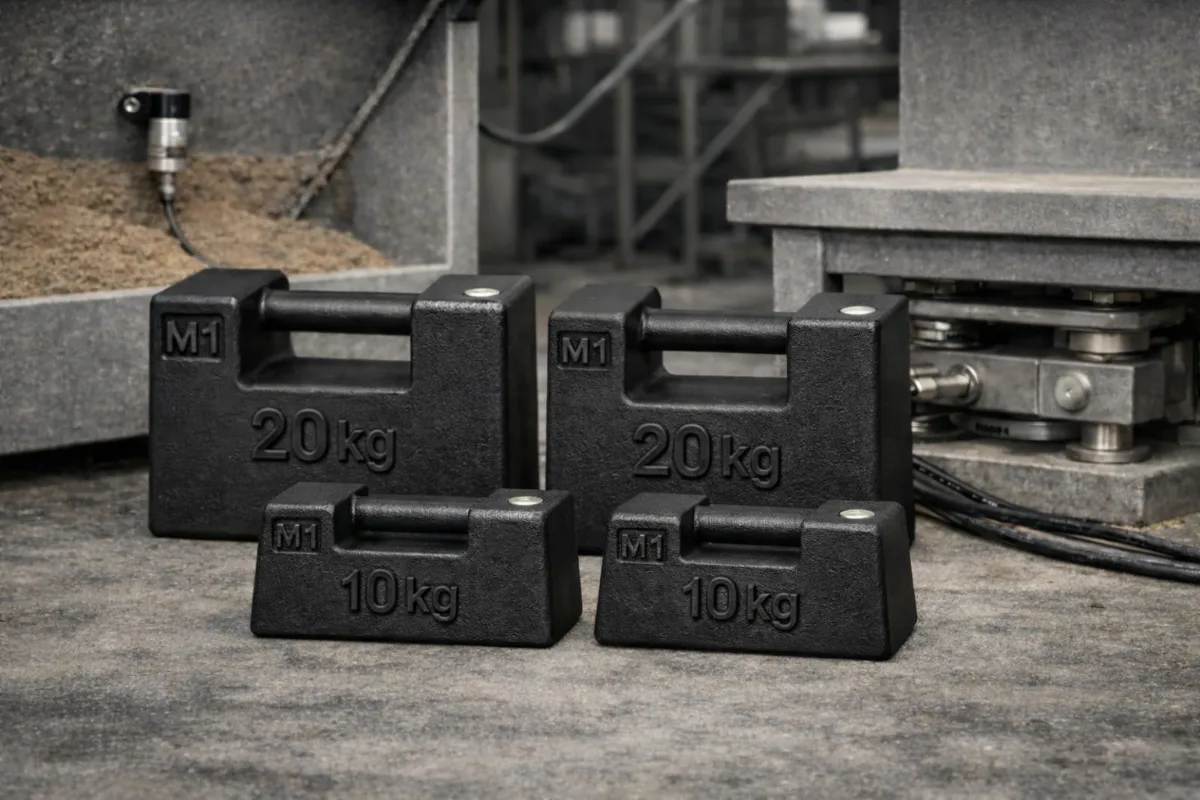
Calibration weights should be of known class and in good condition; verification should be done at multiple load levels rather than a single point. The goal is not to say “I calibrated it once,” but to maintain measurement accuracy continuously. If short-interval checks (zero point, connections, visual inspection) and periodic comprehensive verification are run together based on production intensity, the plant operates more stably, quality variation decreases, and material consumption stays on target. After calibration, a few trial batches should also be used to confirm alignment between the automation display and real practice by checking water amount, admixture consumption, and weighing repeatability.
For original load cells, bunker sand moisture sensors, and calibration weights—contact us for technical support and supply.